

RGV vs Conveyor Block Production Line: Which System Is Better for Modern Block Factories?
As block manufacturing moves toward higher automation and efficiency, choosing the right material handling system has become a critical decision. Two of the most commonly used solutions today are the RGV (Rail Guided Vehicle) block production line and the traditional conveyor block production line.
At first glance, both systems aim to move fresh blocks smoothly through the production process. However, when you look closer, their working principles, flexibility, and long-term value are quite different. So, which one is better for modern block factories? Let’s break it down.
What Is a Conveyor Block Production Line?
A conveyor block production line relies on fixed mechanical conveyors to transport pallets and fresh blocks between stations such as molding, curing, and stacking.
This system has been used for many years and is still common in small to medium-sized block plants. Its main characteristics include:
-
Fixed transportation routes
-
Continuous mechanical movement
-
Simple control logic
-
Relatively lower initial investment
For factories with stable layouts and limited space changes, conveyor systems can still be a practical solution.
What Is an RGV Block Production Line?
An RGV (Rail Guided Vehicle) block production line uses rail-mounted vehicles to transport blocks and pallets. Instead of fixed conveyors, RGVs move independently along rails according to programmed commands.
In an RGV system, block transportation becomes more intelligent and flexible. Vehicles communicate with the central control system and move only when needed, which helps optimize the entire production flow.
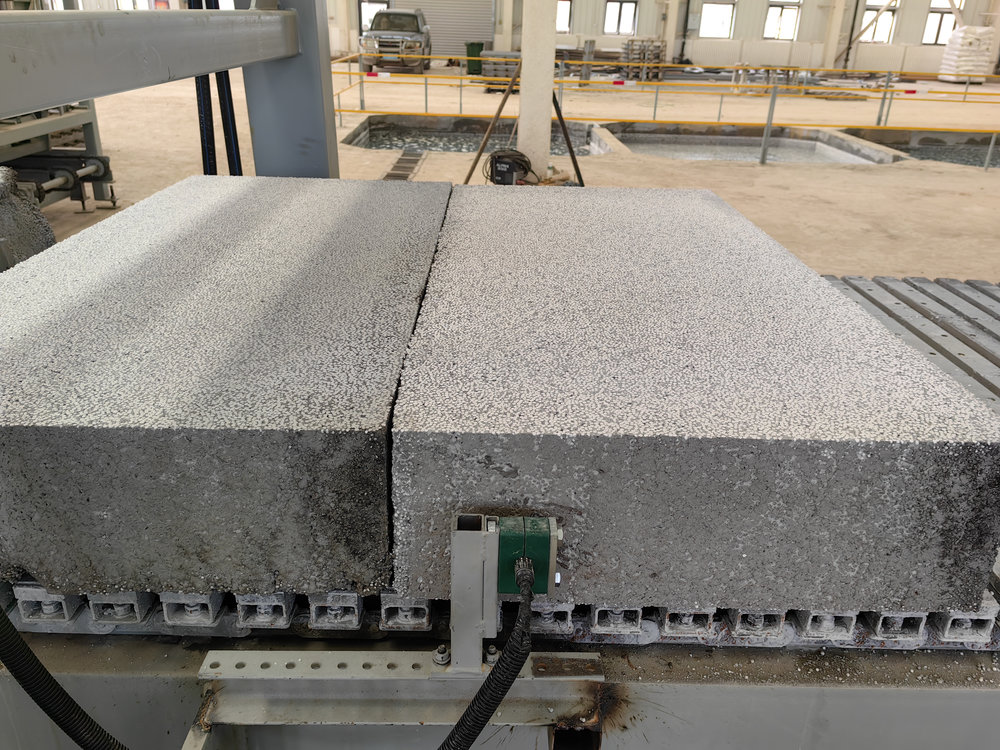
Key Differences Between RGV and Conveyor Systems
1. Layout Flexibility
This is one of the biggest differences.
-
Conveyor systems require fixed routes and specific installation space. Any future layout change usually means dismantling and reinstalling equipment.
-
RGV systems allow more flexible rail design, making it easier to adapt to factory expansion or production upgrades.
For factories planning long-term growth, RGV offers a clear advantage. You don’t get locked into one layout forever, which is a big relief for many owners.
2. Production Efficiency and Flow Control
Conveyors move continuously, whether the next station is ready or not. This can sometimes lead to bottlenecks or unnecessary waiting.
RGV systems, on the other hand, operate on demand. Vehicles move only when required and can be scheduled precisely according to the block machine cycle. This improves coordination between forming, curing, and stacking stages.
In practice, many users find that RGV lines feel more “smooth” during operation.
3. Block Protection During Transport
Fresh blocks are sensitive, especially before curing. Sudden stops or vibrations during transport can affect block surface quality.
-
Conveyor systems may cause continuous vibration due to mechanical movement.
-
RGV vehicles move with controlled acceleration and deceleration, reducing stress on fresh blocks.
Better handling leads to more consistent block quality, which matter a lot in competitive markets.
4. Maintenance and Reliability
Conveyor systems include many rotating parts, chains, rollers, and bearings, which require regular maintenance. Over time, wear and tear can increase downtime.
RGV systems have fewer continuously moving mechanical components. Maintenance mainly focuses on rails, wheels, and control systems. Although the technology is more advanced, long-term maintenance can actually be more manageable.
Some customers say RGV systems run stable for years with proper maintenance, and that’s not an exaggeration.
5. Investment Cost vs Long-Term Value
There is no denying that RGV block production lines usually require a higher initial investment than conveyor systems.
However, when evaluating total cost of ownership, factors such as:
-
Labor reduction
-
Energy efficiency
-
Lower reconfiguration costs
-
Improved production stability
often make RGV systems more cost-effective in the long run. Choosing only based on initial price can be misleading.
Which System Is Right for Your Factory?
A conveyor block production line may be suitable if:
-
Your production scale is small or medium
-
Factory layout is fixed and unlikely to change
-
Budget is limited
An RGV automatic block production line is a better choice if:
-
You plan large-scale or long-term production
-
Factory layout flexibility is important
-
Labor cost is increasing
-
You aim for higher automation and intelligent control
At Hamic, both systems are offered depending on customer needs, but for modern high-capacity plants, RGV solutions are increasingly preferred.
Conclusion
When comparing RGV vs conveyor block production lines, there is no one-size-fits-all answer. Conveyor systems remain practical for simpler operations, while RGV systems represent the future of intelligent, flexible block manufacturing.
As automation standards continue to rise, RGV block production lines are becoming a strategic investment rather than just an equipment upgrade.