

Technical Characteristics and Properties of Polystyrene Concrete
Polystyrene concrete has proven itself as an excellent wall and thermal insulation material. Its properties make it more cost-effective than similar materials (e.g., expanded polystyrene concrete, expanded clay concrete, arbolite, etc.) and traditionally used materials.
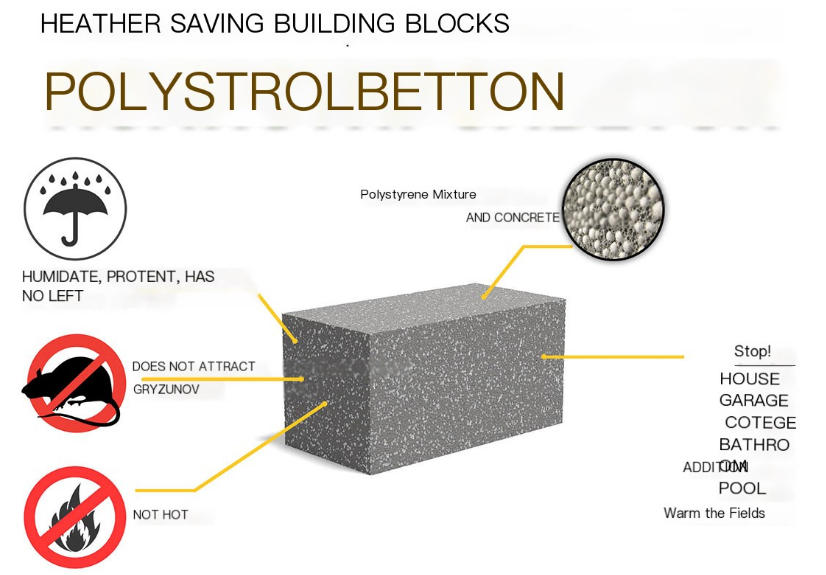
 STRENGTH — used in the construction of load-bearing, self-supporting, and non-load-bearing structures. Withstands distributed loads of up to 35 tons per linear meter with a wall thickness of 30 cm.
 WATERPROOFING – absorbs 4% moisture, which is 4 times less than brick and wood. The risk of mold growth is eliminated.
 PLASTICITY is the only cellular concrete material capable of bending. Its flexural strength is 10% of its compressive strength, while polystyrene concrete has 60%.
 SOUNDPROOFING - 30 cm thick polystyrene block walls absorb over 70 dB of sound (the noise of a passing train), providing excellent soundproofing.
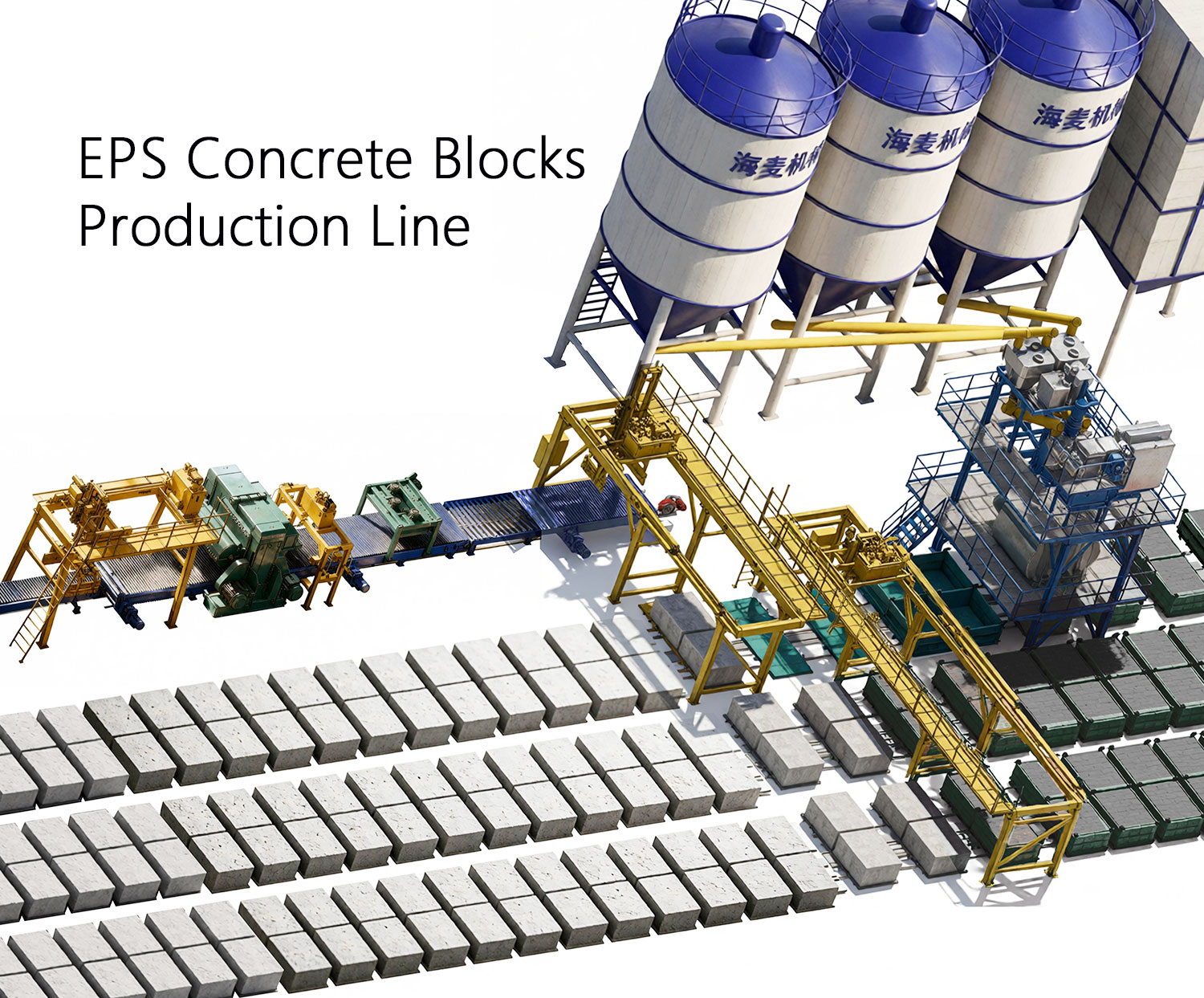
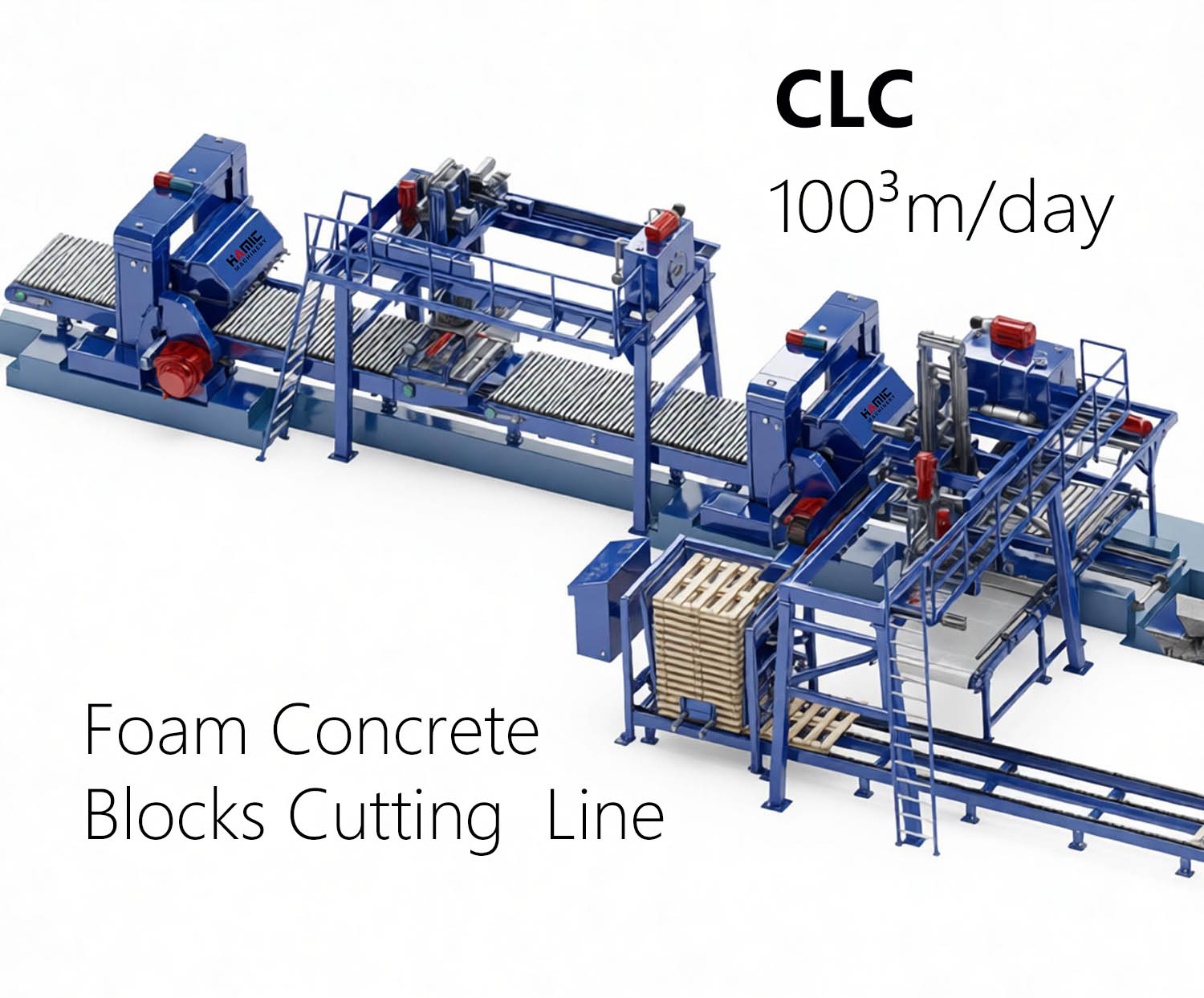
Polystyrene concrete production technology
Comparative characteristics of various building materials
| Material | Density, kg/m3 | Thermal conductivity coefficient, W/(m*C) | heat loss, W/m2 | Wall thickness at Ropr=3.15, m | Weight of 1 m2 of wall, kg |
|---|---|---|---|---|---|
| Solid clay brick | 1700 | 0.81 | 54 | 2.55 | 4337.55 |
| Clay brick (20% voidage) | 1400 | 0.43 | 28.67 | 1.35 | 1896.3 |
| Sand-lime brick | 1800 | 0.87 | 58 | 2.74 | 4932.9 |
| Cellular concrete (autoclaved) | 550 | 0.18 | 17.5 | 0.55 | 303.19 |
| Expanded clay concrete | 850 | 0.38 | 26.67 | 1.18 | 1004.06 |
| Tree | 500 | 0.15 | 33.33 | 0.47 | 236.25 |
| POLYSTYRENE CONCRETE | 450 | 0.13 | 13.33 | 0.30 | 135 |
Recommended areas of application of polystyrene concrete
| Scope of application | Indicators for | |
|---|---|---|
| Medium density | compressive strength | |
| Thermal insulation boards | D150-D250 | M2 - M3.5 |
| Monolithic thermal insulation of attics and roofs | D150-D250 | M2 — M3.5; |
| Monolithic thermal insulation of three-layer panels, blocks and external walls | D200-D250 | M2.5 - M5 |
| Thermal insulation in well masonry | D150-D250 | M2.5 - M3.5 |
| Hollow elements for precast-monolithic walls | D250-D350 | M5; B0.5 - B1.0 |
| Solid blocks or monolithic walls: | ||
| Non-load-bearing | D250-D400 | M5; B0.5 - B1.0 |
| Self-supporting | D350-D450 | B1.0 - B1.5 |
| Load-bearing | D450-D600 | B1.5 - B2.5 |
The relationship between classes and brands of polystyrene concrete by compressive strength
| Concrete strength class | Average strength of concrete R, MPa | The closest brand in terms of strength |
|---|---|---|
| B0.5 | 0.73 | M7.5 |
| B0.75 | 1.09 | M10 |
| B1.0 | 1.45 | M15 |
| B1.5 | 2.16 | M20 |
| B2.0 | 2.90 | M25 |
| B2.5 | 3.60 | M35 |
Standard and calculated resistances of polystyrene concrete
| Type of resistance | Standard resistances of polystyrene concrete and calculated resistances of polystyrene concrete, MPa, for the limit states of the second group for concrete class by compressive strength | ||||||
|---|---|---|---|---|---|---|---|
| M5 | B0.5 | B0.75 | B1.0 | B1.5 | B2.0 | B2.5 | |
| Axial compression (prism strength) Rbh and Rb,ser | 0.35 | 0.5 | 0.75 | 1.0 | 1.5 | 1.8 | 2.1 |
| Axial tension Rbtn and Rbt,ser | 0.12 | 0.15 | 0.21 | 0.26 | 0.3 | 0.32 | 0.35 |
| Bending tensile strength Rbtfn and Rbtf,ser | 0.23 | 0.27 | 0.38 | 0.47 | 0.55 | 0.58 | 0.64 |
| Type of resistance | Calculated resistance of polystyrene concrete, MPa, for limit states of the first group for concrete class by compressive strength | ||||||
| M5 | B0.5 | B0.75 | B1.0 | B1.5 | B2.0 | B2.5 | |
| Axial compression (prism strength) Rb | 0.25 | 0.35 | 0.55 | 0.75 | 1.05 | 1.4 | 1.75 |
| Axial tension Rbt | 0.07 | 0.09 | 0.12 | 0.15 | 0.18 | 0.20 | 0.23 |
| Bending elongation Rbtfn and Rbtfn,ser | 0.14 | 0.16 | 0.22 | 0.28 | 0.32 | 0.35 | 0.40 |
| Polystyrene concrete grade by average density | The initial modulus of elasticity of polystyrene concrete under compression and tension Eб 10-3, MPa, for the concrete class according to compressive strength | ||||||
|---|---|---|---|---|---|---|---|
| M5 | B0.5 | B0.75 | B1.0 | B1.5 | B2.0 | B2.5 | |
| D250 | 0.35 | 0.45 | — | — | — | — | — |
| D300 | 0.40 | 0.50 | 0.60 | — | — | — | — |
| D350 | 0.50 | 0.60 | 0.70 | 1.1 | — | — | — |
| D400 | — | 0.70 | 0.80 | 1.2 | 1.3 | — | — |
| D450 | 1.3 | 1.4 | 1.6 | — | |||
| D500 | — | — | — | — | 1.45 | 1.7 | 1.9 |
| D600 | — | — | — | — | 1.6 | 1.8 | 2.1 |
Thermal performance of polystyrene concrete
Average density grade | Specific heat capacity, kJ/(kg? °C) | Thermal conductivity coefficient in dry state, W/(m? °C) | Calculated mass ratio of moisture in the material, %, under operating conditions | Calculation coefficients under operating conditions | |||
|---|---|---|---|---|---|---|---|
| thermal conductivity, W/(m.°C) | vapor permeability, mg/ (m? h? Pa) | ||||||
| A | B | A | B | (A, B) | |||
| 150 | 1.06 | 0.055 | 4 | 8 | 0.057 | 0.060 | 0.135 |
| 200 | 1.06 | 0.065 | 4 | 8 | 0.070 | 0.075 | 0.120 |
| 250 | 1.06 | 0.075 | 4 | 8 | 0.085 | 0.090 | 0.110 |
| 300 | 1.06 | 0.085 | 4 | 8 | 0.095 | 0,i05 | 0.100 |
| 350 | 1.06 | 0.095 | 4 | 8 | 0.110 | 0.120 | 0.090 |
| 400 | 1.06 | 0.105 | 4 | 8 | 0.120 | 0.130 | 0.085 |
| 450 | 1.06 | 0.115 | 4 | 8 | 0.130 | 0.140 | 0.080 |
| 500 | 1.06 | 0.125 | 4 | 8 | 0.140 | 0.155 | 0.075 |
| 550 | 1.06 | 0.135 | 4 | 8 | 0.155 | 0.175 | 0.070 |
| 600 | 1.06 | 0.145 | 4 | 8 | 0.175 | 0.200 | 0.068 |